How to Upload a File Using Javascript React


How to Multipart File Upload Using FormData with React Hook Course
In this case, nosotros will learn how to upload files with React Hook Form, which is very preferred for managing forms with React. Nosotros will use FormData to upload a file and nosotros will upload a file of type multipart/form-information.
Introduction
We will examine step by step how to utilise the Multipart file upload procedure, which is more often than not used to upload an image or file to a server, with React Claw Form. Let's first create a unproblematic express server to upload the files. Then, let's upload our files to this server with the React Hook course. Permit'due south start!
Create Express Server
npm i limited
So, let's install the cors packet necessary to allow file upload to the server, and the limited-fileupload packet to manage the paths of the downloaded files.
npm i cors express-fileupload
We have completed our installations to create a simple server. This server will indicate that the file has been uploaded successfully or failed, in response to a POST call to an endpoint that nosotros accept specified.
import express from " express " ; import fileupload from " express-fileupload " ; import cors from " cors " ; const app = express (); app . use ( fileupload ({ createParentPath : true , }), ); app . use ( cors ()); app . apply ( express . json ()); app . utilize ( express . urlencoded ({ extended : true })); app . post ( " /upload-file " , async ( req , res ) => { endeavour { if ( ! req . files ) { res . ship ({ condition : " failed " , message : " No file uploaded " , }); } else { let file = req . files . file ; console . log ( req . files ); file . mv ( " ./uploads/ " + file . name ); res . send ({ status : " success " , bulletin : " File is uploaded " , information : { proper noun : file . proper noun , mimetype : file . mimetype , size : file . size , }, }); } } grab ( err ) { res . status ( 500 ). send ( err ); } }); const port = process . env . PORT || 5000 ; app . listen ( port , () => panel . log ( `Server started on port ${ port } ` ));

We created a server with Express. Every bit you can run across, nosotros take successfully started our server, now we have an endpoint to handle requests to this port. Now permit'due south create a React projection and send our files to this server with React Hook Form.
Create React Project
Let's create a react project with Create React App and then install the necessary packages for our project.
npx create-react-app react-hook-form-multipart-upload
Subsequently your project is ready, allow's go to our project directory and install the React Hook Form package.
cd react-hook-form-multipart-upload npm install react-claw-form npm run beginning
Multipart File Upload with React Claw Form
We created our React project and installed our react hook form parcel. Now permit'south create a form and manage it with the react claw class.
import React from " react " ; import { useForm } from " react-claw-form " ; function App () { const { register , handleSubmit } = useForm (); const onSubmit = () => {}; return ( < div className = "App" > < form onSubmit = { handleSubmit ( onSubmit ) } > < input type = "file" { ... register ( " file " ) } /> < input blazon = "submit" /> </ form > </ div > ); } consign default App ;
To manage our grade and its elements, we defined the annals and handleSubmit methods from the react hook grade. Now, allow's upload the file selected in our onSubmit method to our server by placing it in the formData.
import React from " react " ; import { useForm } from " react-hook-form " ; function App () { const { annals , handleSubmit } = useForm (); const onSubmit = async ( data ) => { const formData = new FormData (); formData . append ( " file " , data . file [ 0 ]); const res = wait fetch ( " http://localhost:5000/upload-file " , { method : " POST " , body : formData , }). then (( res ) => res . json ()); alarm ( JSON . stringify ( ` ${ res . message } , condition: ${ res . status } ` )); }; return ( < div className = "App" > < form onSubmit = { handleSubmit ( onSubmit ) } > < input type = "file" { ... register ( " file " ) } /> < input blazon = "submit" /> </ course > </ div > ); } export default App ;
Our projection is ready! With React Hook Form, we can at present ship the selected file to our server in multipart/form-information type. Let's test it!

Are You Looking React Web Framework?
A React-based framework for edifice internal tools, apace. refine offers lots of out-of-the box functionality for rapid development, without compromising extreme customizability. Use-cases include, but are not limited to admin panels, B2B applications and dashboards.
🔥 Headless : Works with any UI framework
⚙️ Zero-configuration: I-line setup with superplate. It takes less than a minute to showtime a projection.
📦 Out-of-the-box : Routing, networking, authentication, country management, i18n and UI.
🔌 Backend Agnostic : Connects to any custom backend. Congenital-in support for Residue API, Strapi, NestJs CRUD, Hasura, Nhost, Airtable, Supabase, Appwrite and Altogic.
📝 Native Typescript Core : You can ever opt-out for apparently JavaScript.
🐜 Enterprise UI : Works seamlessly with Ant Design System. (Support for multiple UI frameworks is on the Roadmap)
📝 Average-gratuitous Lawmaking : Keeps your codebase make clean and readable.
Refer to the refine documentation for more data. →
How to Multipart File Upload with Refine and React Hook Form?
It allows you to manage your forms and ship data to your server with the refine-react-hook-form adapter it publishes with its refine headless characteristic. With this adapter, y'all tin can use all the features of the React Hook Class in harmony with refine. You can as well perform Multipart File Upload(multipart/class-information) operation very easily using this adapter.
Refer to the refine-react-hook-form adapter documentation for detailed information. →
View Source
You lot can manage your course very easily with the refine-react-hook-form adapter. The data created in the course will be automatically saved to the database with the refine onFinish method.
This is a basic CMS app that was created with refine'south headless feature. Y'all may quickly build records and save them to your database using refine. We'll expect at the CreatePost page of this step. We'll create a record in the form and manage it with the refine-react-hook-course adapter.
Refine Create Post Folio:
import { useState } from " react " ; import { useForm } from " @pankod/refine-react-hook-form " ; import { useSelect , useApiUrl } from " @pankod/refine-core " ; import axios from " axios " ; export const PostCreate : React . FC = () => { const [ isUploading , setIsUploading ] = useState < boolean > ( false ); const { refineCore : { onFinish , formLoading }, register , handleSubmit , formState : { errors }, setValue , } = useForm (); const apiURL = useApiUrl (); const { options } = useSelect ({ resource : " categories " , }); const onSubmitFile = async () => { setIsUploading ( true ); const inputFile = document . getElementById ( " fileInput " , ) as HTMLInputElement ; const formData = new FormData (); formData . suspend ( " file " , inputFile ?. files ?. detail ( 0 ) equally File ); const res = await axios . mail < { url : cord } > ( ` ${ apiURL } /media/upload` , formData , { withCredentials : fake , headers : { " Access-Command-Allow-Origin " : " * " , }, }, ); setValue ( " thumbnail " , res . data . url ); setIsUploading ( false ); }; render ( < form onSubmit = { handleSubmit ( onFinish ) } > < characterization >Title: </ characterization > < input { ... register ( " title " , { required : true }) } /> { errors . title && < bridge >This field is required</ span > } < br /> < label >Status: </ characterization > < select { ... register ( " condition " ) } > < choice value = "published" >published</ option > < option value = "typhoon" >typhoon</ option > < option value = "rejected" >rejected</ option > </ select > < br /> < label >Category: </ characterization > < select defaultValue = { "" } { ... register ( " category.id " , { required : true }) } > < selection value = { "" } disabled > Please select </ option > { options ?. map (( category ) => ( < option key = { category . value } value = { category . value } > { category . characterization } </ selection > )) } </ select > { errors . category && < span >This field is required</ span > } < br /> < characterization >Content: </ characterization > < br /> < textarea { ... annals ( " content " , { required : true }) } rows = { 10 } cols = { 50 } /> { errors . content && < span >This field is required</ span > } < br /> < br /> < label >Image: </ label > < input id = "fileInput" type = "file" onChange = { onSubmitFile } /> < input blazon = "hidden" { ... register ( " thumbnail " , { required : truthful }) } /> { errors . thumbnail && < span >This field is required</ bridge > } < br /> < br /> < input type = "submit" disabled = { isUploading } value = "Submit" /> { formLoading && < p >Loading</ p > } </ form > ); };
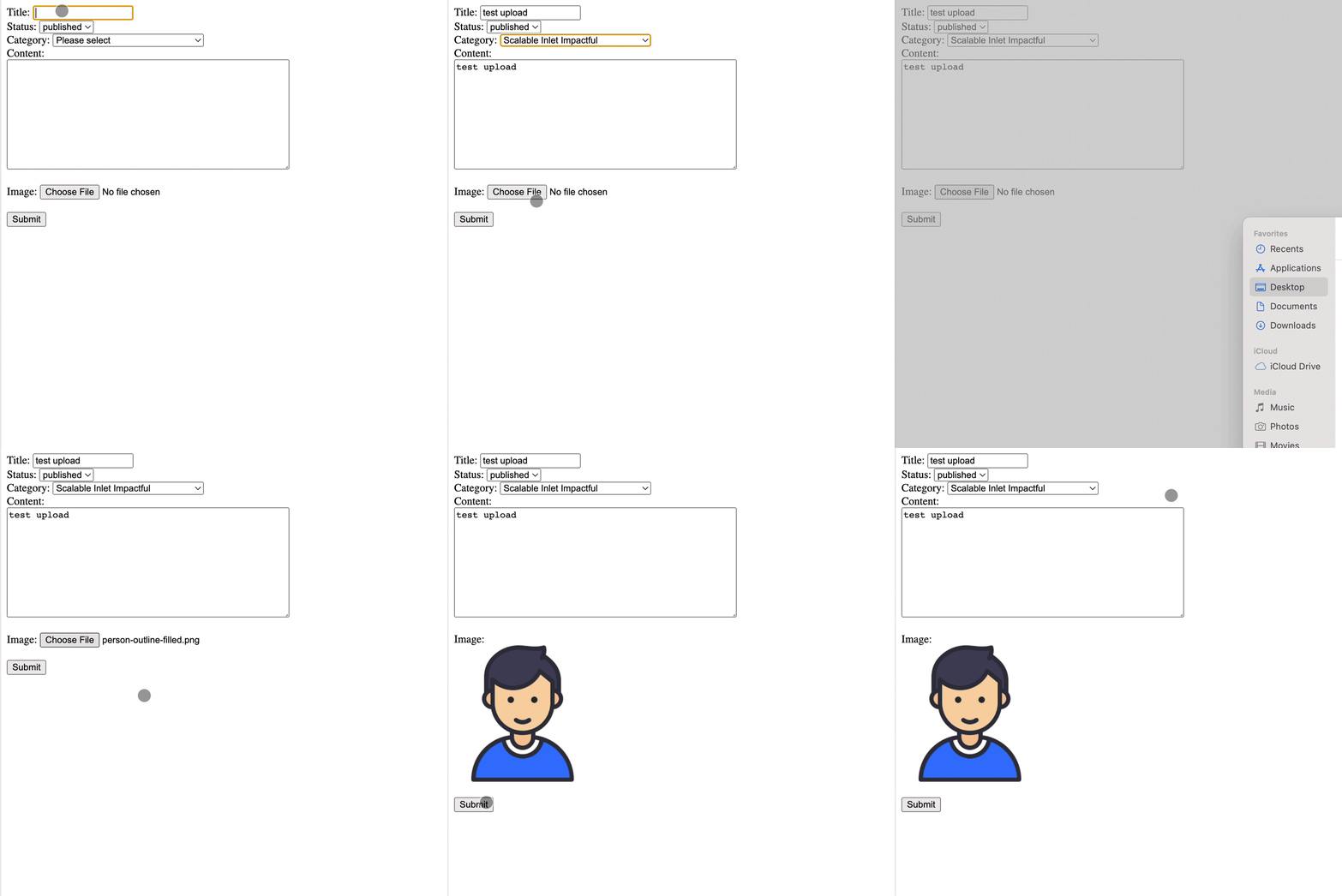
Every bit you can run into, we have easily saved both our information such as title, category, condition and an image in the form of multipart/form-data to our database using the refine-react-hook-form adapter. We've but shown how to utilize the Multipart File Upload feature for our instance in this tutorial. For examine refine CMS example, checkout the live codeSandbox below.
Refine Multipart Upload Live CodeSandbox Example
Source: https://dev.to/pankod/how-to-multipart-file-upload-using-formdata-with-react-hook-form-4d6d
0 Response to "How to Upload a File Using Javascript React"
Post a Comment